
 The callback that said `SUCCESS`
The callback that said `SUCCESS`
Friday, the app said Paid. Monday, 15,000 XOF was missing. The callback was named SUCCESS. That was the whole problem.
Finance opens the settlement file on Monday morning. Three rows from Friday's mobile money batch do not match the ledger. Support already closed the tickets — the app showed Payment successful. Product is asking why ops is "reopening" a green launch.
The provider was not lying. Your system mapped SUCCESS to settled when the provider only meant accepted for processing.
This is the most common reconciliation gap we see in West African fintech audits. It is also the direct sequel to mobile money integration patterns: same rails, sharper vocabulary.
Three meanings hiding in one word
On paper, every provider exposes something like SUCCESS, FAILED, or PENDING. In production, teams discover at least three distinct moments:
| Moment | What the provider often means | What finance means |
|---|---|---|
| Accepted | Request received; debit may still fail | Nothing yet — do not recognize revenue |
| Confirmed | User wallet debited; funds in float | Liability moves; still not bank-settled |
| Settled | Batch file / bank transfer closed the loop | Can match settlement report line-for-line |
Wave, Orange Money, and Free Money do not use the same names. Some send SUCCESS on the first callback and never send a second. Others send COMPLETED days later in a CSV. A few expose a status API where SUCCESS still returns settlementStatus: PENDING.
If your domain model has one boolean — isSuccessful — you will eventually lie to at least one audience.
The sequence most teams assume
Monday, 09:12
Finance opened the batch file. OM-88421 was not in it.
Here is what the weekend hid. Friday 16:44, a FAILED callback left the provider. Your endpoint was saturated: it never landed. Saturday, the status API still said success — settlement still pending. Nobody in ops checked — the ticket was already green.
Three systems, three truths. The app says paid. The provider says pending. The bank says nothing. The 15,000 XOF never moved.
Not an outage: a word that meant accepted, stored as confirmed, reported as settled.
Stop copying the word
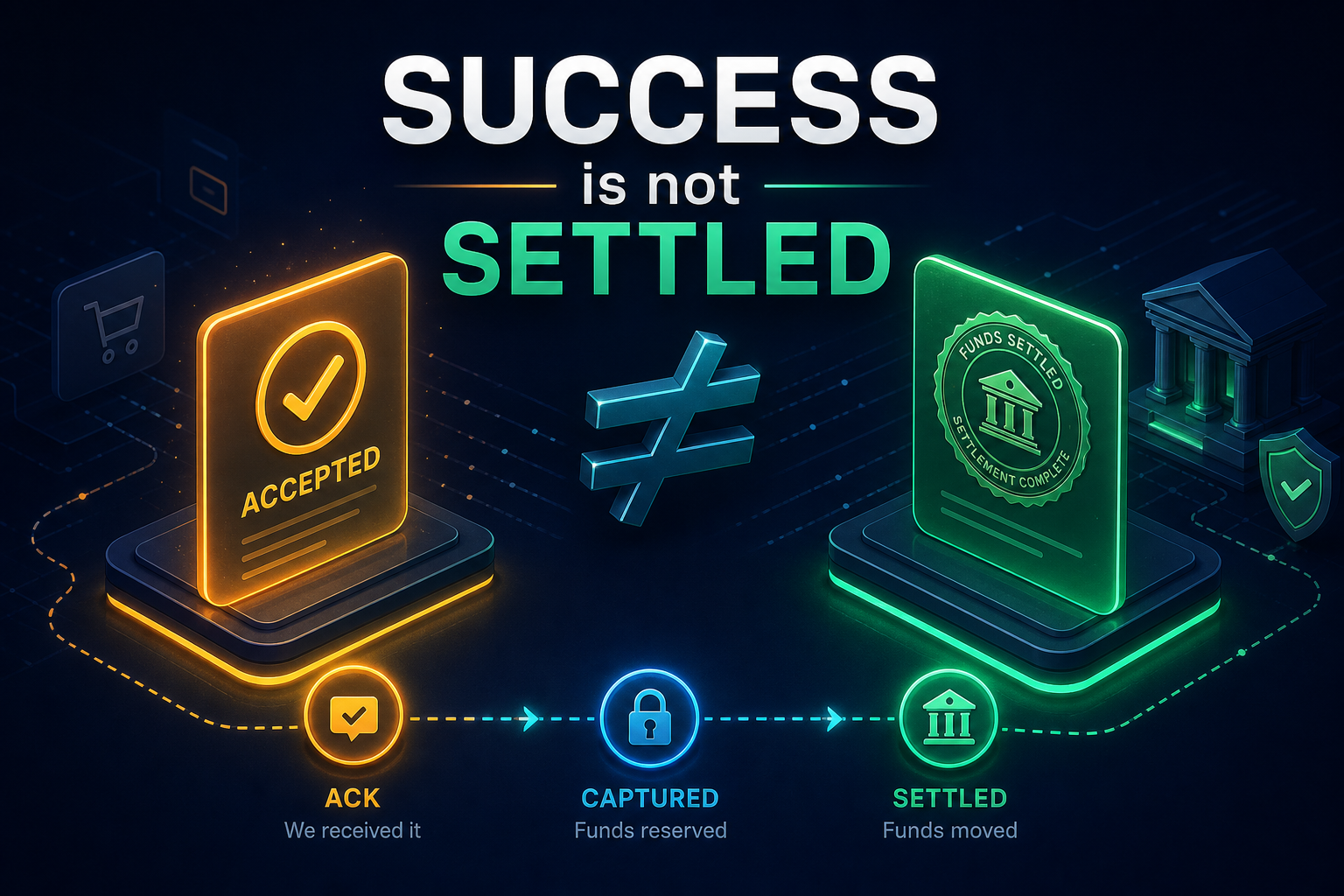
The first SUCCESS is an ACK: the request was received. Processing. Not Paid.
A provider status is not a business status. It is an event to interpret.
These are not three translations of the same word. They are three different facts:
ACK — the provider received or accepted the request. CAPTURED — value actually moved on the rail: debit or credit. SETTLED — finance recognizes the row in settlement or reconciliation. FAILED even if an earlier callback announced success.
Show the user ACK or CAPTURED. Post to the ledger at CAPTURED or at SETTLED — one policy, formally documented. Mix them, and Monday morning starts again. Reconciliation closes a gap; it does not create francs.
Never set settledAt on the first callback. The handler that maps instead of copying is detailed in mobile money integration patterns.
The Monday that should have happened
If Friday's SUCCESS had become ACK, the app would have said Processing. Support would have seen an active intent. The missed FAILED would have surfaced on the next poll. And Monday's file would have been accurate: no row, because nothing was captured.
Finance would not have been hunting a ghost in a green launch. They would have been handling one stuck payment.
Same rails. Same callback. Different dictionary.
A callback is a sentence in the provider's language. Your architecture must translate it before it becomes a financial fact.
The next lie
SUCCESS was the first lie. The next one will be a silence.
The provider did not go down: it went slow. Three seconds of silence — enough for an impatient client to retry, then retry again. Same merchant, same amount, three transfers in flight.
Ninety seconds from a double payout.